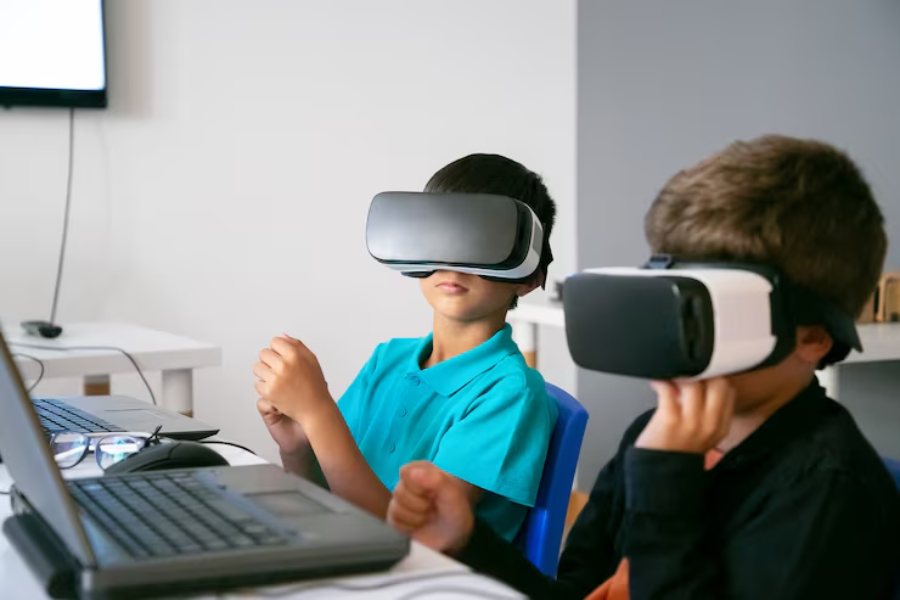
Virtual Reality (VR) is rapidly becoming one of the most transformative technologies in the education sector. This immersive technology is revolutionizing the way students learn, providing them with opportunities to engage in interactive and experiential learning environments that were previously impossible. In recent years, VR has been successfully integrated into various educational settings, from K-12 schools to universities, offering students unique and innovative ways to experience subjects and enhance their understanding of complex concepts.
By creating virtual spaces where students can explore, practice, and experiment, VR not only helps improve engagement but also allows for personalized and hands-on learning experiences. Whether it’s simulating historical events, exploring the human body, or visualizing abstract scientific principles, the applications of VR in education are endless.
How can Virtual Reality be used in education?
Virtual Reality (VR) is transforming education by offering immersive, interactive learning experiences. VR can simulate real-world scenarios, allowing students to explore historical events, scientific concepts, or artistic creations in ways that textbooks cannot. It enhances engagement and provides hands-on learning opportunities that improve understanding and retention. From K-12 to higher education, VR is revolutionizing the way we teach and learn.
How Virtual Reality is Revolutionizing Education
Virtual Reality (VR) is a powerful tool that can reshape education by providing immersive learning experiences that engage students on a deeper level. This section will explore the fundamental ways VR is used in educational settings.
Introduction to VR in Education:
Virtual Reality is a technology that creates a simulated environment, offering users the opportunity to interact with three-dimensional, computer-generated environments in a way that feels real. In education, VR has emerged as a game-changer by allowing students to immerse themselves in experiences that enhance learning. Instead of passively receiving information, students can actively engage with content.
Real-World Examples of VR in Education:
Many educational institutions have successfully implemented VR to improve student engagement and learning outcomes. For instance, universities are using VR simulations for medical students to practice surgeries, while history classes are taking virtual tours of ancient Rome or Egypt. VR technology is also being used in language learning programs, where students are immersed in a virtual environment where they can interact with native speakers. One notable example of VR’s success is the use of custom virtual reality in training institutes, where it has been used to simulate complex tasks, such as operating machinery, in a safe and controlled environment.
Benefits for Students and Teachers:
For students, VR provides hands-on learning that encourages active participation, which leads to deeper understanding and better memory retention. By experiencing simulations of real-world scenarios, students can practice problem-solving, critical thinking, and decision-making skills.
Challenges and Limitations:
While VR holds immense potential in education, its integration into classrooms comes with challenges. The cost of VR equipment, including headsets and specialized software, can be a significant barrier for many schools, especially in underfunded areas. Additionally, the technology requires proper infrastructure, including high-speed internet and space for VR activities, which may not be available in all educational settings. Another limitation is the need for teacher training to ensure effective use of VR tools.
Future Outlook:
Looking ahead, the future of VR in education seems bright. As technology becomes more affordable and accessible, it is expected that more schools and universities will adopt VR in their classrooms. Advancements in custom virtual reality development will likely lead to even more specialized educational tools, allowing for tailored, curriculum-specific experiences. With the continued evolution of VR, the potential for creating highly immersive, interactive, and personalized learning environments will revolutionize the way education is delivered, breaking down traditional barriers and opening up new opportunities for students worldwide.
Why Virtual Reality is the Future of Education
Virtual Reality has the potential to revolutionize education by offering immersive and engaging experiences. This section will focus on why VR is increasingly seen as the future of learning.
Section Breakdown:
- Engagement through Immersion: Students can interact with digital content in a way that traditional textbooks and media cannot match.
- Hands-On Learning Opportunities: VR allows students to engage in simulations, improving understanding of complex concepts.
- Increased Retention and Memory: Studies suggest that VR increases retention rates by offering experiential learning.
- Scalable Learning Environments: VR creates the possibility for classrooms to be virtually limitless, offering educational access to anyone, anywhere.
- Personalized Learning Experiences: VR can adapt to individual learning needs, providing tailored lessons and practice scenarios.
Each section will use real-life examples of VR applications in classrooms to demonstrate its potential as the future of education.
How Can VR be Used for Virtual Field Trips?
One of the most exciting applications of Virtual Reality (VR) in education is the ability to take students on virtual field trips. This innovative use of VR enables students to travel to faraway places, explore historical sites, or even venture into outer space—all from the comfort of their classroom. Virtual field trips offer incredible benefits, including accessibility, engagement, and the opportunity to explore diverse educational content that may not otherwise be possible due to logistical, financial, or geographical constraints.
1. Historical Tours and Museum Visits
One of the most powerful aspects of VR in education is the ability to take students on immersive historical tours and museum visits. Rather than simply reading about ancient civilizations, students can experience these cultures firsthand by exploring virtual reconstructions of famous sites like the Pyramids of Egypt, the Colosseum in Rome, or Machu Picchu in Peru. VR allows students to walk through these historical landmarks, examine artifacts up close, and even interact with virtual exhibits. This hands-on, experiential learning helps students better understand and appreciate the significance of historical events, while also bringing history to life in a way that traditional textbooks cannot.
Benefits:
- Interactive Exploration: Students can explore ancient ruins, historical landmarks, and museums from around the world.
- Access to Rare Artifacts: Students can view and interact with items that may be difficult to access in real life.
- Engagement in History: Students are more likely to remember historical events when they experience them in an immersive, visual way.
2. Exploring Outer Space
Imagine a classroom where students can take a trip to outer space, exploring distant planets, stars, and galaxies. With VR, this becomes a reality. Instead of reading about the solar system, students can virtually fly through space, witnessing firsthand the beauty of Saturn’s rings, the surface of Mars, or the vast expanse of the Milky Way galaxy. They can also simulate space missions, interact with space probes, and even explore alien landscapes. VR in space education allows students to experience space in a way that was once impossible—giving them a sense of awe and wonder, while also deepening their understanding of astronomy and space science.
Benefits:
- Immersive Space Exploration: Students can experience outer space like never before, gaining a deeper understanding of our universe.
- Increased Curiosity About Science: Virtual space tours can inspire interest in fields such as astronomy, physics, and engineering.
- Hands-on Learning: Students can virtually operate spacecraft, solve challenges, and engage in scientific experiments related to space exploration.
3. Underwater Adventures
With VR, students no longer need to dive into the ocean to explore marine life. Virtual underwater adventures allow students to visit coral reefs, observe marine animals in their natural habitat, and even explore the ocean floor—without ever getting wet! Students can virtually dive alongside dolphins, swim through schools of fish, or explore shipwrecks, gaining an understanding of ocean ecosystems and marine biology in a way that would be impossible in the classroom alone. This unique experience promotes environmental awareness and a deeper appreciation for the preservation of our oceans.
Benefits:
- Access to Ocean Exploration: Students can experience underwater environments that are difficult or dangerous to access in real life.
- Learning About Marine Life: Students can learn about marine biology, oceanography, and the importance of preserving aquatic ecosystems.
- Fostering Environmental Awareness: Virtual underwater experiences help students develop a greater sense of responsibility for protecting the planet’s oceans and marine life.
4. Cultural Exploration
One of the most enriching uses of VR in education is its ability to expose students to different cultures and lifestyles from around the world. Virtual field trips can take students to bustling marketplaces in Marrakech, ancient temples in India, or remote villages in the Amazon rainforest. These virtual experiences provide students with a global perspective, helping them understand the diversity of cultures, traditions, and ways of life. VR cultural exploration fosters empathy, encourages open-mindedness, and gives students a greater appreciation for the world beyond their own borders.
Benefits:
- Exposure to Different Cultures: Students can experience and interact with the cultures, traditions, and daily lives of people from various parts of the world.
- Global Awareness and Empathy: VR helps students develop a broader worldview, increasing cultural sensitivity and empathy for others.
- Educational Travel Without the Expense: Students can explore foreign cultures and environments without the costs and logistics of physical travel.
By integrating VR field trips into the classroom, educators can unlock new and exciting learning experiences for their students. These virtual experiences not only make learning more engaging but also provide access to knowledge and places that were previously out of reach. With VR, the world is at students’ fingertips—whether it’s exploring the depths of the ocean or the outer limits of space, these virtual field trips offer invaluable educational opportunities that help students grow intellectually, socially, and emotionally.
Benefits of Virtual Reality for Teachers
Teachers can leverage VR to enhance their lessons, making learning more interactive, engaging, and effective. This section will discuss the benefits of using VR from the educator’s perspective.
Section Breakdown:
- Immersive Teaching Methods: VR enables teachers to create immersive lessons, turning complex topics into easily understandable visual experiences.
- Active Participation: Students are no longer passive recipients of information, but active participants in their learning, which improves engagement and focus.
- Real-Time Feedback: VR systems can provide immediate feedback to students, helping them understand concepts and mistakes as they go.
- Creating Customizable Lessons: Teachers can design and customize VR lessons tailored to specific learning goals and student needs.
- Professional Development for Teachers: VR offers opportunities for teachers to engage in virtual teaching simulations, improving their own skills.
This section will highlight how VR offers unique benefits for educators, helping them to teach more effectively and engage their students better.
Conclusion:
Virtual Reality is paving the way for a new era in education, offering immersive, engaging, and personalized learning experiences. As we’ve explored, VR is being used in various ways to enhance classroom learning, provide virtual field trips, and offer teachers new ways to engage their students. Despite challenges such as cost and accessibility, the future of VR in education looks promising, with the potential to make learning more interactive, dynamic, and effective than ever before.
FAQs:
How can VR improve student engagement?
VR creates an immersive and interactive environment, which engages students by making learning fun, dynamic, and hands-on. Students are more likely to remember content when they can actively participate in simulations and experiences.
Is VR accessible for all educational institutions?
While VR technology can be expensive, many schools are finding ways to integrate VR with grant funding or partnerships. As VR technology becomes more widespread, it will become more affordable and accessible.
Can VR be used for all subjects in education?
Yes, VR can be used for a wide range of subjects, from history and science to literature and art. Its versatility allows it to adapt to any subject matter, offering interactive and immersive learning experiences.
What are the health concerns related to VR in education?
Some students may experience motion sickness or eye strain when using VR. It’s important for educators to monitor usage and ensure that students take regular breaks to minimize these issues.
Will VR replace traditional teaching methods?
VR is not meant to replace traditional teaching methods but rather to complement them. It provides a new and engaging way for students to learn, while still allowing teachers to use their existing teaching tools and techniques.