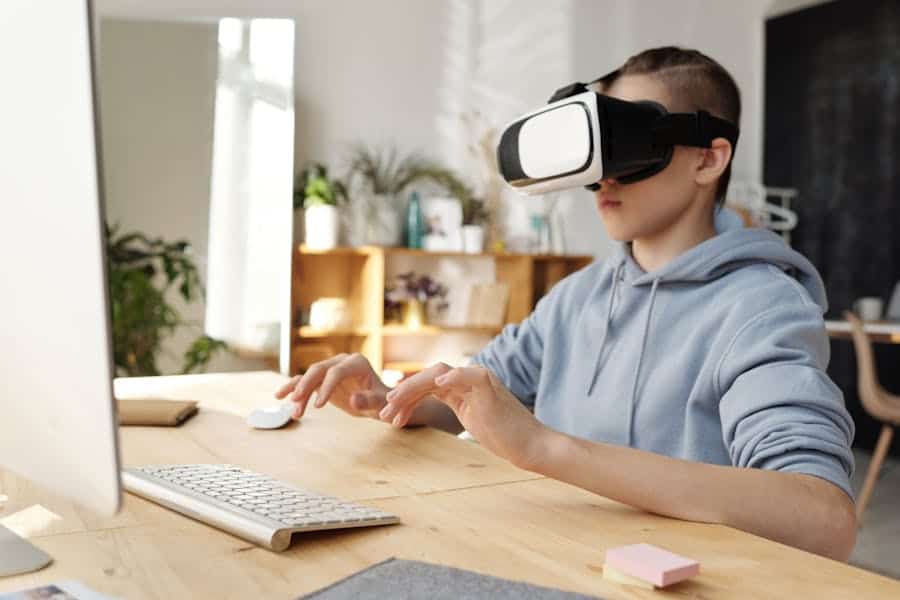
Virtual Reality (VR) can enhance education by providing hands-on experiences and simulations for students. It allows them to explore complex concepts and scenarios not easily accessible in traditional classrooms, improving learning outcomes and retention.
By simulating real-world interactions, VR fosters deeper connections with learning materials, creating a more engaging and memorable educational experience. Through immersive learning, students can visit historical sites, travel globally, or experience phenomena like climate change.
VR has the potential to revolutionize education by making learning more interactive, engaging, and impactful.
The Rise Of VR In Modern Classrooms
Experience the transformative power of VR in modern classrooms as it brings learning to life. VR provides immersive, hands-on experiences that allow students to explore and interact with complex concepts, environments, and scenarios, fostering deeper engagement and understanding in education.
From historical sites to scientific simulations, VR enhances learning on a personal and emotional level.
The use of virtual reality in modern classrooms has become increasingly popular, as it opens up a world of possibilities for both teachers and students. Revolutionizing traditional teaching methods, VR technology allows for a more immersive and interactive learning experience. With the ability to simulate real-world experiences and interactions, students can connect with learning materials on a deeper, more personal level.
Benefits for Teachers and Students
One of the key benefits of VR in education is its ability to provide students with hands-on experiences and simulations. This allows them to explore and interact with complex concepts, environments, and scenarios that may not be readily available or feasible in a traditional classroom setting. As a result, students are able to learn and retain information more effectively.
Additionally, VR technology can also benefit teachers by providing them with new and innovative ways to present information. With the ability to create immersive and engaging learning experiences, teachers can capture the attention of their students and make learning more enjoyable.
In conclusion, the rise of VR in modern classrooms has the potential to revolutionize the way we approach education. By providing students with hands-on experiences and simulations, they are able to learn and retain information more effectively. Furthermore, VR technology also benefits teachers by providing them with new and innovative ways to present information. As this technology continues to evolve, it will be exciting to see how it shapes the future of education.
Virtual Field Trips: Exploring Without Limits
Welcome to the world of virtual field trips, where students can explore without limits. Through the power of virtual reality (VR), educational experiences are no longer confined to the walls of a classroom. Instead, students can embark on immersive journeys to historical sites, global landmarks, natural wonders, and scientific expeditions, all from the comfort of their school or home.
Historical Sites And Global Landmarks
Step back in time and witness history come alive as students virtually visit ancient civilizations, iconic landmarks, and significant historical events. With VR, they can stroll through the ruins of ancient Rome, stand at the base of the Great Pyramid of Giza, or witness the signing of the Declaration of Independence. These virtual field trips provide an unparalleled opportunity for students to gain a deeper understanding of historical events and cultures.
Natural Wonders And Science Expeditions
From the depths of the ocean to the expanse of outer space, VR enables students to embark on awe-inspiring journeys through natural wonders and scientific expeditions. They can dive into the Great Barrier Reef to explore marine life, traverse the Amazon rainforest to study biodiversity, or even journey to Mars to experience the challenges of space exploration. These virtual expeditions foster a profound appreciation for the natural world and ignite curiosity about scientific phenomena.
Enhancing Stem Education With VR
Virtual Reality (VR) technology has the potential to revolutionize STEM education by providing immersive and interactive learning experiences. By leveraging VR, educators can introduce innovative teaching methods that engage students and enhance their understanding of science, technology, engineering, and mathematics (STEM) concepts.
Interactive Science And Math Modules
VR offers a unique opportunity to create interactive modules that allow students to explore complex scientific and mathematical concepts in a virtual environment. By utilizing VR headsets, students can visualize abstract theories, such as molecular structures or mathematical equations, in a three-dimensional space. This hands-on approach fosters a deeper understanding of challenging topics, making science and math more accessible and engaging for learners.
Real-world Engineering And Tech Simulations
Through VR simulations, students can engage in real-world engineering and technology scenarios, such as building structures, designing circuits, or troubleshooting mechanical systems. These immersive experiences enable students to apply theoretical knowledge to practical situations, enhancing their problem-solving skills and critical thinking abilities. By interacting with virtual engineering projects, students gain valuable insights into the applications of STEM principles in the professional world.
Credit: soeonline.american.edu
VR’s Role In Special Needs Education
Virtual Reality (VR) has opened up new possibilities in the field of education, particularly in catering to the unique needs of students with special needs. The immersive and interactive nature of VR technology has proven to be instrumental in creating tailored learning experiences, improving accessibility, and fostering inclusion for students with diverse learning requirements.
Tailored Learning Experiences
VR technology allows educators to create customized learning experiences that cater to the specific needs and abilities of students with special needs. Through VR simulations and scenarios, students can engage with content in a personalized manner, addressing individual learning styles and preferences. This tailored approach enhances the learning experience and promotes better comprehension and retention of educational material.
Improving Accessibility And Inclusion
One of the key benefits of VR in special needs education is its ability to improve accessibility and foster inclusion. VR environments can be designed to accommodate various accessibility requirements, ensuring that students with physical or cognitive limitations can fully participate in educational activities. Additionally, VR experiences can create a sense of inclusivity by allowing students to engage in collaborative learning and social interactions within virtual spaces, regardless of their physical abilities.
Collaborative Learning In Virtual Spaces
- Social Interaction And Communication :
Virtual reality (VR) provides a unique platform for students to engage in social interaction and communication. Through immersive experiences, learners can interact with each other in virtual environments, fostering real-time communication and collaboration. - Building Teamwork And Community :
In virtual spaces, students have the opportunity to build teamwork and community through collaborative learning experiences. They can work together on projects, solve problems, and engage in group activities, promoting a sense of camaraderie and shared achievement.
Evaluating VR Learning: Metrics And Feedback
As virtual reality (VR) continues to gain traction in the education sector, it’s crucial to assess its effectiveness in enhancing learning experiences. Evaluating VR learning involves the use of various metrics and feedback mechanisms to gauge student performance and engagement. Let’s explore the assessment tools, student performance, and engagement analytics in VR education.
Assessment Tools In VR
Assessment tools in VR play a pivotal role in gauging the effectiveness of virtual learning experiences. These tools enable educators to measure students’ understanding, knowledge retention, and skill development within immersive virtual environments. By leveraging VR assessment tools, educators can gain valuable insights into students’ progress and adapt teaching strategies accordingly.
Student Performance And Engagement Analytics
Student performance and engagement analytics offer a comprehensive view of how learners interact with VR-based educational content. Through performance analytics, educators can track students’ achievements, identify areas of improvement, and tailor personalized learning paths. Engagement analytics provide valuable data on students’ levels of participation, attention, and overall immersion in VR learning experiences, allowing educators to optimize content and delivery for maximum engagement.
Frequently Asked Questions
How Does VR Integrate With Education?
VR integrates with education by giving students immersive simulations that help them interact with complex ideas, practice real situations, and build stronger connections with learning material.
How Can VR Be Used In An Educational Setting?
VR supports learning by offering interactive experiences that explain difficult topics, improve focus, and make lessons more engaging through realistic, hands-on activities.
What Is An Example Of VR In Education?
A common example is a virtual field trip where students visit historical locations or explore scientific environments through immersive simulations.
How Is VR Used In Special Education?
VR helps special education students by creating safe, controlled environments that support skill building, reduce stress, and offer experiences that might be difficult to access in real life.
How Can Virtual Reality Enhance Learning Experiences?
Virtual reality enhances learning by delivering realistic simulations that increase participation, strengthen understanding, and make challenging topics easier to grasp.
Conclusion
VR can reshape classroom experiences by placing students inside realistic simulations instead of only reading or watching from a distance. Through guided activities and interactive scenes, they can handle complex ideas in a more concrete way and practice real world tasks in a safe setting. This approach supports stronger focus and clearer connections between concepts and their practical use. When schools consider How Can VR Be Used In Education, they can use it for virtual labs, field trips, training scenarios, and skill practice. With thoughtful planning, VR becomes a powerful tool for richer, more effective learning.